





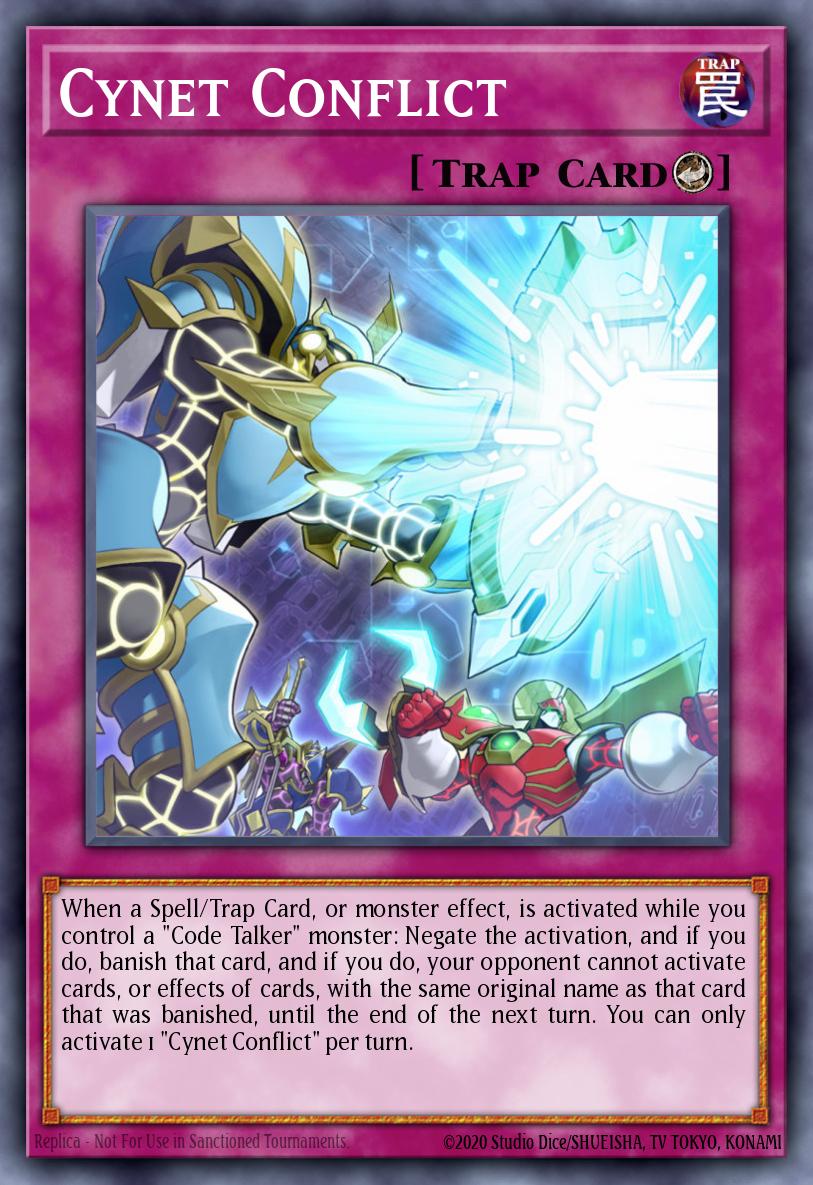

 Trap
 Counter
Cynet Conflict
Archetype:
Code Talker
View:
5221
When a Spell/Trap Card, or monster effect, is activated while you control a "Code Talker" monster: Negate the activation, and if you do, banish that card, and if you do, your opponent cannot activate cards, or effects of cards, with the same original name as that card that was banished, until the end of the next turn. You can only activate 1 "Cynet Conflict" per turn.
Cynet Conflict — Power Evaluation
Final Score: 58 ± 6 · Confidence: Medium
- Intrinsic: 58 · Deck: 58 · Meta: provisional
- Primary role: Removal / Negation · Secondary: Floodgate/Control
Why it scores here
Cynet Conflict is a set Trap whose value is conditional negation: it needs a face-up Code Talker monster, is once per turn, and converts a negated activation into a banish plus a same-name lock. The effect_interaction axis carries the score, and it is capped by the Code Talker condition and by the set-trap timing. Its 400/400 deck presence and 100% combo appearance are conditional on the sample being filtered to decks that already run the card, so they confirm it is a real, practical pick but do not add points beyond that. Its high inclusion does not move the score on its own, and the single-combo sample gives little evidence of combo conversion.
Axis scores
| Axis | Score | Evidence |
|---|---|---|
| Accessibility | 60 | Set Trap that needs a Code Talker monster on the field; present in all 400 sampled decks and 1 combo, but starter role/searched-for role are not recorded (observed, with inference on set-turn timing). |
| Combo & Conversion | 25 | Its one recorded combo has no combo role entry and the board power index is not attributable to this card (observed; the card is not a starter or payoff). |
| Resource Economy | 45 | Negates and banishes the opponent's card 1-for-1 and costs itself, so no net advantage; the same-name lock is tempo, not card gain (verified from text, inferred for value). |
| Effect & Interaction | 72 | Negates Spell/Trap and monster effect activations and adds a same-name activation lock until end of the next turn; strong when online but gated by Code Talker presence (verified from text). |
| Material Utility | 5 | A Trap is never Material and has no body on the field (verified from card type). |
| Resilience & Flexibility | 45 | Once per turn and needs a live Code Talker monster; a set Trap can be answered before the chain (verified from text, inferred for interaction). |
| Deck-Building Efficiency | 75 | Single-copy average (1.07), no garnet or self-lock, and typical copies is 1; the card is cheap to run in its home decks (observed from copies distribution and usage statistics). |
Calculation
Weight profile: Primary role Removal / Negation; no secondary blend applied (secondary Floodgate/Control shown in secondary_roles only). Intrinsic ≈ 58, Deck ≈ 58, Meta = provisional. Modifiers: none. Final formula: 0.40*Intrinsic + 0.60*Deck
Strengths
- Strong, flexible negation of Spell/Trap and monster activations when a Code Talker monster is out
- Same-name lock after banishing turns a single negation into a follow-up restriction
- Single copy, no garnet, cheap to run in its home decks
Weaknesses
- Requires a face-up Code Talker monster to do anything; dead without one
- Once per turn, so it cannot stack negations in one turn
- Set-trap timing: it must be set beforehand and can be answered before it resolves
Counters / choke points
- Losing or never having a Code Talker monster on the field (the activation condition fails)
- Opponent responding with their own negation or in-chain response before the activation resolves
- Going second against a set trap they can see (inferred from set-trap timing; not recorded in combos evidence)
Best use
Removal / Negation trap for Code Talker control shells. Decks: Code Talker (Trap Control), Code Talker (Pure), Cynet, Mathmech. Suggested copies: 1.
Evidence & gaps
- Verified: Trap type; once per turn; requires a Code Talker monster; negates Spell/Trap and monster effect activations; banishes the negated card; same-name lock until end of next turn (card text); Archetype Code Talker; formats TCG, OCG, MasterDuel, DuelLinks (card data)
- Observed: Present in 400 of 400 sampled decks, average 1.07 copies, 1 copy in 384 (deck data; sample is filtered to decks that run the card); Usage statistics: inclusion 61.5% to 100% across 4 archetype/gameplay homes, typical copies 1 (usage statistics); Appears in 1 combo, 0 starter/searched/material/payoff roles recorded (combo data)
- Inferred: Accessibility of 60 reflects set-turn timing and dependence on a live Code Talker monster rather than a recorded starter route; Deck and resilience scores assume the sampled home archetypes match Code Talker-based shells
- Data gaps: no banlist token — assumed 3 copies (unlimited) deck data sample is filtered to decks running the card, so 100% presence is by construction only 1 combo recorded; combo conversion is weakly evidenced no combo role entries; starter/searched/material roles unavailable no guides describe Cynet Conflict's role directly beyond general Code Talker control context